
Long range planning is underway for a extra fast hardtail mountain bike that should be done in the spring. Similar to the Corsair, it will have a 686mm BCD tire on the front. Suspension forks for such a bike are expected around then.
Word has it that an upcoming 120mm fork for 32″ wheel is going to have a slider plane 1.5° angle from the head axis. A pitched slider. This isn’t common in bicycles or motorcycles. Typically, the slider plane is aligned with the head axis.
It does happen. Some chopper motorcycles pitched sliders. Early RockShox RS-1 and MAG 21 forks did. Recently, gravel forks produced by several top suppliers have used sliders planes set at an angle to the head axis. I write about that in the following post.
In that post, I discuss the geometric concerns for using this type of fork in a bike design. Basically, how we ensure our geometry is what we say it is when it’s being planned and constructed with pitched sliders. This was relatively straightforward.
The question arises, what effect does this produce in the system and why would we implement it? In the case of the current gravel forks, it’s clearly being done to clean up the visual aesthetic of the fork to make it more palatable for the consumer. Having an inline connection of the axle to the slider significantly cleans up the look of the bike and may make the low travel system a little lighter.
Now, we have a new situation. A fork that will look like any other mountain bike fork but has pitched sliders. The essential architecture of the fork is otherwise identical to those slider plane is aligned to the head axis. Why would this choice be made?
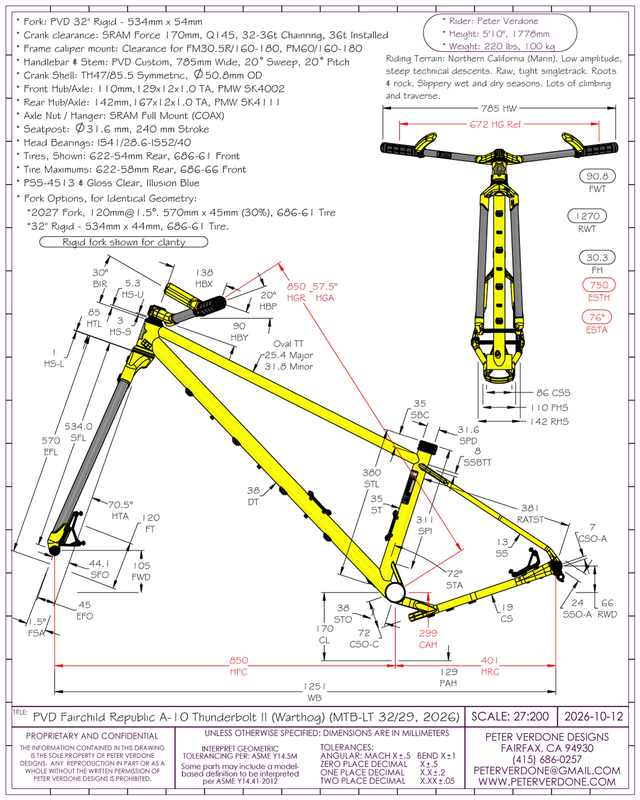
I did some calculations based on my upcoming MTB-LT, the Warthog. So that it is clear what values may have been used in my calculations, I’ll include a print of that bike design.
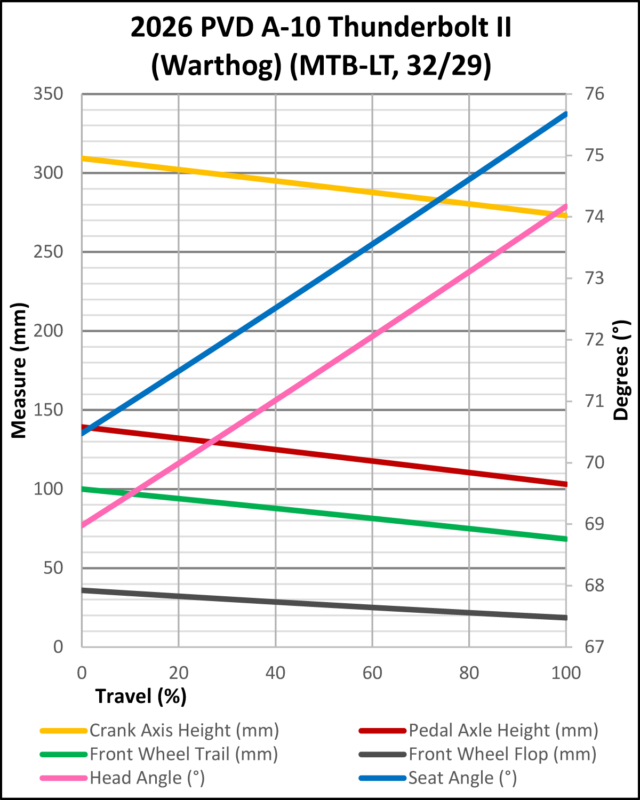
I can gain some understanding of what happens with the front end and crank axis by doing some basic math. The entirety of the bike’s geometry was used to do these calculations to ensure precise representation. Honestly, the main value that I get from this is for producing a highly optimized crank axis height in my design.
Let’s setup a comparison. I’ll look at just the front wheel trail and the front wheel flop, what would be different if the system had a slider aligned with the steerer? Offset was adjusted so that both forks were 44.1mm at 30%. Nothing else changed. I show that below.
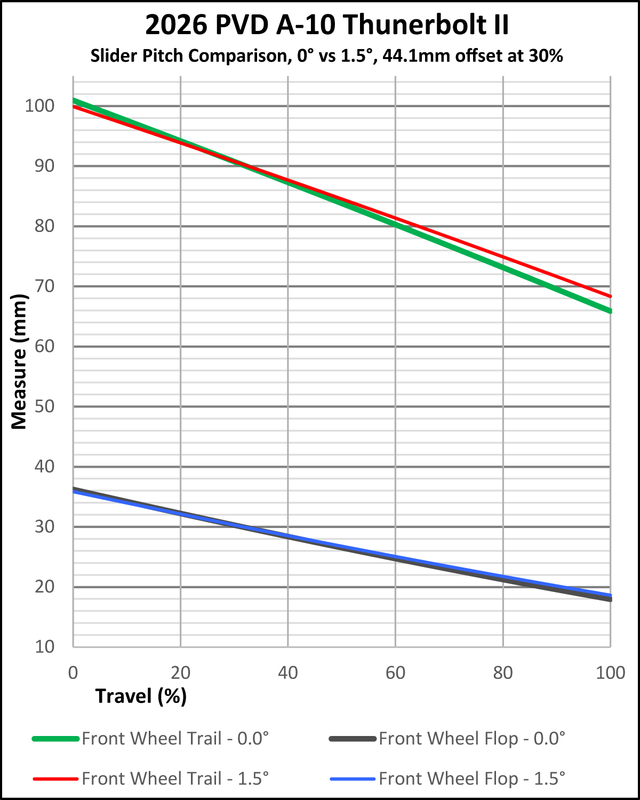
While the wheel flop changes a trivial amount, the front wheel trail change is measurable. Both have a trail of 90.8mm at 30%. At 100% compression: 68.3mm with the pitched slider and 65.9mm the parallel slider.
That’s 24.8% reduction in trail for the pitched slider and 27.4% reduction in the parallel slider. A 2.6% difference at 100% from 30% travel.
Looking at the difference in trail change alone, one would imagine that this is enough of a marginal gain to be worth the effort. Who wants their bike to become less stable in the most extreme of situations, even by just a little bit? I don’t.
But the bike is a system and all changes have knock on effects. If you rob from Peter, your going to have to pay Paul. What costs are you paying for this imagined advantage?
Most obvious is that geometry planning of the bike is more complex. This is acceptable for me if the effort is worth it but most folks have a very hard time with basic planning. I discuss this in the post above about the new gravel forks. Is the geometry confusion really worth the imagined gain if it results in a poorly planned system that actually negates that gain?
Think of it this way, as of this writing, BikeCAD Pro 24.5 is available but has no provision for a pitched slider fork other than manually adjusting the offset at a given point. I’m sure that this will be remedied soon but it does tell you how much effort has been put into this idea in the last 20 years.
But here’s the real cost, worse suspension performance. Telescoping forks have serious problems dealing with forces that aren’t aligned with the sliders. If the forces are misaligned (always) here will always be some component of stanchion bind, where the sliders resist sliding due to the bending forces going through the fork. For a long time, this wasn’t a huge issue for mountain bikes. Head angles were sufficiently steep and other factors were more problematic that station bind rarely got discussed. In 2026 and in the last 10 years, it’s become a real problem. Some bikes have head angles as low as 63° or 62°. The only time forks on these bikes work is when pointed down a steep chute. Good in a gravity race, terrible everywhere else.
With a gravel bike, that 5° pitched stanchion may be aligning the slider to the angle of the forces….but it’s probably not. Again, my mountain bikes are on the low side of what is common for gravel bikes (70°-72°) and I ride some very aggressive and rocky descents. I’m not looking for a lower slide pitch. A bike that is generally dealing with small surface bumps is going to want something far more vertical for best function. We are only left to believe that the 5° is making gravel bikes work worse in favor of appearance, not better.
While a deep dive into whether low head angles are an advantage or not is the topic of another post, it should be clear that using a fork that reduces the slider angle to earth 1.5° – 5.0° degrees is not wise for at least 98% of a given offroad ride.
My Starfighter MTB uses a 68° head angle. The Warthog should have a 70.5° head angle. I’ve been looking for ways to increase head angles in the last 7 years to reduce flop and advantage suspension over most of the ride. I’ve got the least to loose using this fork. Others will not be as lucky.
Will you be seeing steeper head angles on new 32″ model bikes? Definitely not. My prediction is that most 32″ wheeled bikes will have even slacker head angles or very short front centers or both. We’re already seeing this happen. Why? Simply, handlebars, stems and pour design remain the big problem in commodity bike designs.